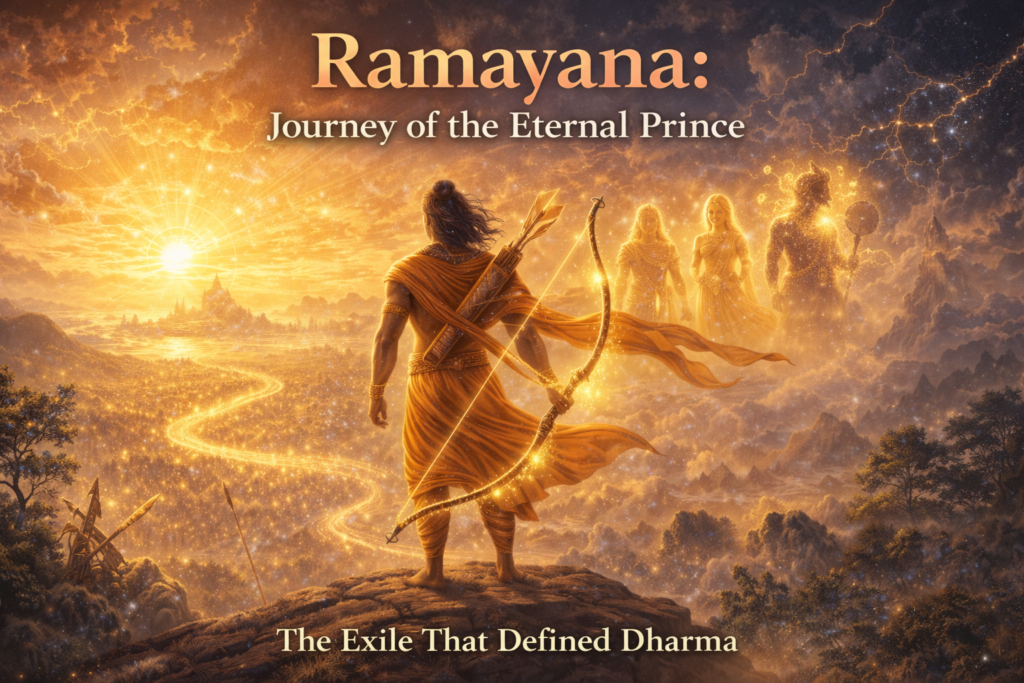
The coronation that Ayodhya had awaited with songs and garlands never came. Instead, the city was draped in sorrow. Rama, once prepared to ascend the throne, now prepared to walk into exile. The people wept openly, their voices rising in protest, but Rama’s face shone with serenity. For to him, exile was not disgrace, but duty.
He entered Kausalya’s chambers to bid farewell. His mother, who had dreamed of seeing her son crowned king, now broke into tears. “How can I live without you, my child? Fourteen years without seeing your face is death itself.” Rama bowed at her feet and spoke gently: “Mother, do not grieve. A son’s duty is to uphold his father’s word. If I go, I go with joy, for in my exile lies the honor of our house. Think not of loss, but of dharma fulfilled.”
Kausalya wept, yet seeing Rama’s calmness, she steadied her heart. She realized her son was not leaving in despair, but walking in dignity.
Next came Sita. Many advised her to stay in the palace, to live in comfort until Rama’s return. But her voice was firm, her eyes unwavering: “Where you go, I go. The forest shall be my palace, your exile my joy. Do not think I am fragile, Rama. I was born to walk beside you, in ease and in hardship alike.” Her words revealed the true power of love—not in clinging to comfort, but in sharing sacrifice.
Then came Lakshmana, fierce and devoted. He declared: “Brother, where you tread, I tread. I will guard you and Sita in the forest, I will serve you with every breath. Do not think of me as separate from you.” Such was his loyalty that he refused to let Rama walk alone, proving that true devotion is not in words, but in companionship through trial.
Thus the three set forth—Rama, Sita, and Lakshmana—leaving the palace behind, their faces calm, their spirits unshaken. The people of Ayodhya could not bear it. They followed in great crowds, weeping, pleading: “Do not leave us, Rama! Without you, our city is empty. You are our king, even if you wear no crown.”
But Rama, ever firm, turned to them and said: “Go back, my beloved people. Do not grieve. For a king’s duty is not only to rule but to uphold dharma. If I abandon my father’s word, what example do I set? Let me go, and when I return, I will serve you with greater love.” His words struck their hearts like arrows, for they saw that his greatness was not in seizing power, but in sacrificing it.
As they crossed the rivers and forests, the exiles reached the banks of the Ganga. There stood Guha, chief of the Nishadas, who loved Rama as a brother. He fell at Rama’s feet, weeping: “Stay with me, O Prince. My kingdom is yours, my home your shelter. Do not wander like an ascetic.” But Rama smiled, embracing him. “O Guha, your love is my wealth. Yet my vow is my path. I cannot break it.”
So Guha ferried them across the sacred river, tears falling as his boat carried away the dearest of friends.
The journey brought them to the ashram of sage Bharadwaja, and then to Chitrakoot, a forest of beauty, where rivers sang and trees stood tall. There, Rama built a simple hut of leaves and branches. To the world it was a hut, but to him it was a palace of peace. For happiness, he knew, is not in gold but in contentment.
Meanwhile, back in Ayodhya, Bharata returned from his maternal uncle’s house, only to find the palace shrouded in mourning. His father, Dasharatha, had died of grief, unable to endure separation from Rama. When Bharata learned the truth—that his mother Kaikeyi had demanded Rama’s exile to secure his crown—his heart broke. He rejected the throne, cursed his mother’s actions, and declared: “I will not rule while Rama wanders in exile. He alone is king, I am but his servant.”
With ministers, sages, and citizens, Bharata set out to the forest, determined to bring Rama back. When the brothers met, their embrace was filled with tears. Bharata pleaded: “Return, my brother. Rule Ayodhya. I do not want the crown. The people do not want me. Only you can lead them.”
But Rama stood firm: “No, Bharata. Our father gave his word, and I must honor it. A son who breaks his father’s promise is no son at all. Let me walk my path. Return and serve as guardian of Ayodhya in my absence.”
Bharata wept, but seeing Rama’s resolve, he placed Rama’s sandals upon the throne, saying: “I will not rule as king. I will serve as regent, until you return. These sandals will sit upon the throne as the symbol of your authority.” Such was Bharata’s humility that he lived not as king but as caretaker, waiting for Rama’s return, keeping the kingdom in trust for his brother.
This chapter of the Ramayan teaches us one of its greatest lessons: resilience in sacrifice. Rama lost his crown, his father, and his home, yet he did not lose his dignity. Sita lost her comforts, yet she did not lose her devotion. Lakshmana gave up ease, yet he did not lose his loyalty. Bharata gave up power, yet he did not lose his humility.
Each one shows us that sacrifice is not weakness—it is strength. True resilience is not merely surviving hardship, but embracing it with dignity.
In our lives too, we face exiles. Sometimes it is the loss of a job, the betrayal of trust, the collapse of plans we cherished. We feel as though we have been cast out of the palace into the wilderness. In those moments, the easy path is complaint, despair, and bitterness. But Rama shows us another way. Accept, endure, and walk forward with calmness.
Exile is not the end—it is the forge of greatness. It was in the forest that Rama’s leadership grew, that his bonds deepened, that his true strength emerged. Likewise, our trials are not curses but classrooms, shaping us into who we are meant to become.
When life takes away your comforts, remember Sita in the hut of leaves. When duty demands you sacrifice ambition, remember Rama smiling as he walked into the forest. When loyalty tempts you to falter, remember Lakshmana refusing to leave his brother’s side. When pride whispers for power, remember Bharata placing sandals upon the throne.
These are not stories of the past—they are mirrors of our present. They remind us that resilience is not simply enduring trials, but walking through them with grace.
The exile of Rama is not only the tale of a prince cast into the forest. It is the reminder that every hardship can be faced with dignity. That every sacrifice, when embraced with courage, becomes the path to greatness.
If this story touched your heart, if it reminded you that your struggles are preparing you for something greater, support this journey of dharma with a symbolic donation of eleven dollars. And unlock Dharma Vault, claim it through the link in the description.